|



|
|
|
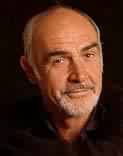 Sean Connery
 Catherine Zeta-Jones
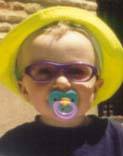 Alex
Alex
|
When the wheels of his plane touched the runway at Madrid's Barajas
International Airport, Alex officially became an international
traveler.
Alex and his parents passed through customs, then took a
wild ride in a hotel van,
and were soon downtown in Spain's capital city. Madrid is a
city that contains countless images of a bear picking fruit from a tree.
It's a city that, in colonial days, held dominion over Florida,
Texas, California, Mexico, and much of Central and South America.
It's also a city where pedestrians don't seem to enjoy a right of way over vehicular traffic. In American cities, at least those in the northeast, those on foot tend to stride boldly into the street, confident that motorists will slow down or stop if necessary. In Madrid, that assumption is reversed. Alex's parents learned this lesson early, as they watched from the windows of the Hotel Atlantico shuttle. Pedestrians scattered like bowling pins at the sight of the onrushing van. It was almost entertaining, in a perverse sort of way. |
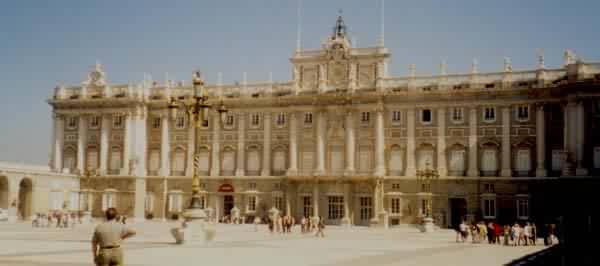 The Palacio Real, or Royal Palace.
The last monarch to live here was Alfonso XIII, who fled in 1931 during
the Spanish Civil War.
Spain's current king, Juan Carlos I,
lives elsewhere but uses the palace for official functions.
The Palacio Real, or Royal Palace.
The last monarch to live here was Alfonso XIII, who fled in 1931 during
the Spanish Civil War.
Spain's current king, Juan Carlos I,
lives elsewhere but uses the palace for official functions.
|
|
Alex enjoyed his three days in Madrid.
Although an old city, (it's been the capital
of Spain since 1607) Madrid has no shortage of young people.
It's almost like a huge college campus.
The sidewalks, whether along the Gran Via or the
smaller side streets, are teeming with people under the age of 30. Alex,
an American boy in a European capital, thrived on the city's youthful
vitality. He truly became part of Madrid, as Madrid became a part of him.
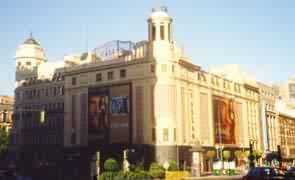
Five stories above street level, the hotel windows were literally vibrating. Alex's parents, groggy and zombie-like from jetlag, sat in a stupor and wondered if every night in Madrid would be like this. (Alex was unfazed by the sonic bombardment from across the street. He spent the evening happily running around the hotel room with his mother's bathing suit on his head.) The music finally came to a stop when Catherine Zeta-Jones herself, draped in a white gown, pulled up in a limousine and entered the theater. The crowd then dispersed, having happily traded a lifetime of hearing for a glimpse of a movie star.
|
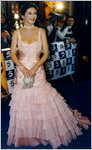 The star arrives
|
|
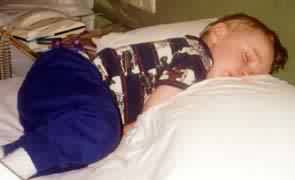
| Alex sleeps off some jet lag in a Madrid hotel. At right, a movie palace along the Gran Via. The posters are for La Trampa, naturally. | |
Two of Madrid's top tourist destinations are the Palacio Real and
the Museo del Prado. For a boy Alex's age, a visit to a royal
palace and an art museum is more to be endured
At the palace, Alex's parents opted for the self-guided tour, which leads from one opulent room to another. The palace has 2,800 rooms, and needless to say, only a small fraction of these rooms are available for public viewing. Each room on the tour is brimming with priceless decorations and artifacts. While many of the palace's treasures were beneath his interest, there were a few items that captured his attention. In each room, he would gaze at the ceilings, which were painted with elaborate murals that generally depicted heavenly angels. In a room that contained a large collection of antique musical instruments, Alex enjoyed looking at the many pianos, violins, and horns. He was especially excited to spot a harp, the instrument that he associates with his favorite Marx Brother. There were also tables that, instead of legs, were supported by sculpted lions, and a billiards table that was "just like Grandpa's." (Actually, the table was just a little bit fancier than the one in Alex's grandfather's basement, if you want to split hairs!)
The Prado was too big, though, and the collection too vast, for Alex to be able to maintain any kind of enthusiasm. By the end of the visit, Alex was tired and cranky. As we said earlier, toddlers and art museums don't really mesh, but Alex did about as well as could be expected.
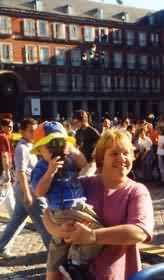
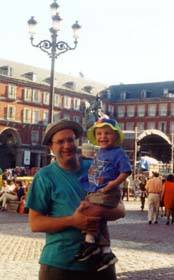
After people watching in the Plaza Mayor, Alex did some animal watching at Zoo Madrid. The zoo, which is only three subway stops from downtown, is located in a large city park. Zoo Madrid is similar to many of the better zoos in the United States, although there are a few key differences:
After three days in Madrid, it was time for Alex and his parents to begin the automotive portion of their Spanish vacation. On Sunday morning they picked up their "Spain car" and headed south on the Autovia to the land of La Mancha, and the city of Toledo. |
|||||||||
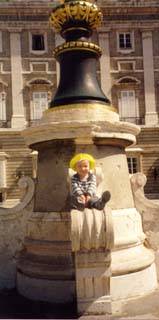
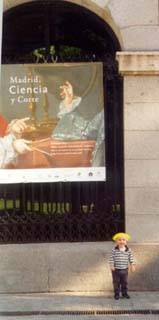
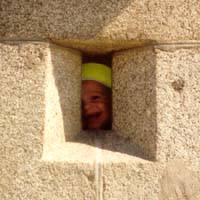 Alex peers out of a window of a guardhouse in the palace courtyard.
|
|
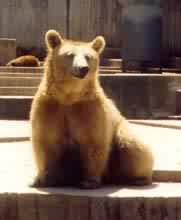
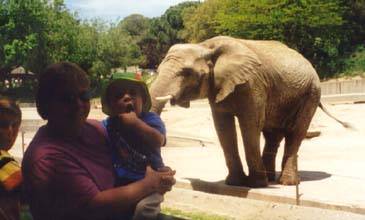
| At Zoo Madrid, this friendly bear was happy to pose for photographs. At right, Alex and his mother pose in front of an unidentifed elephant. We have to wonder, does the elephant know he's in Spain? Does he care? Definitely something to ponder... | |

|
|
|
|||||||||||||||
|
|||||||||||||||
|
|||||||||||||||







Write to The Alexander Home Page
All contents copyright 1997, 1998, 1999, 2000
The Alexander Home Page,
a division of LeapToad Enterprises.